
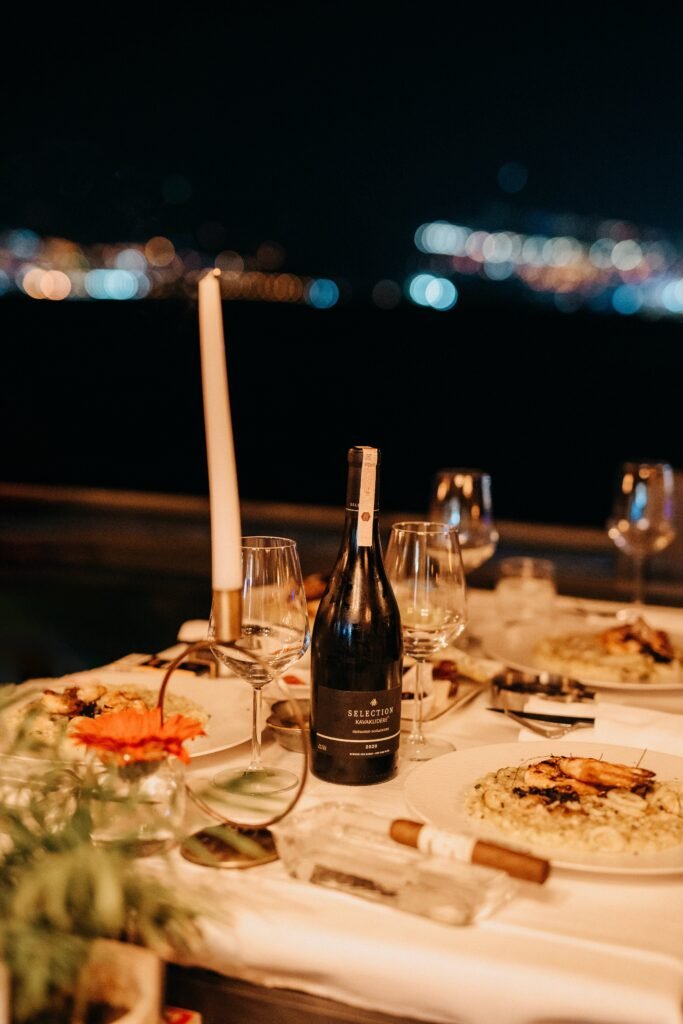
Most men are uncomfortable in fine dining restaurants. Not because they do not belong there. Because no one taught them how to behave there.
The result is men who avoid the experience entirely, or who go and feel vaguely anxious throughout, or who fake their way through it and hope no one notices.
None of this is necessary. Fine dining is not complicated. It has conventions — a specific way things are done and a specific reason they are done that way — and knowing those conventions transforms the experience from intimidating to genuinely pleasurable.
Here is what you need to know.
The Reservation — Start Here
A fine dining restaurant without a reservation is a fine dining restaurant you are probably not getting into. Book in advance. Two weeks minimum for most restaurants. A month or more for the most sought-after tables.
Call rather than booking online when possible. Speaking to a human allows you to communicate preferences — a quiet table, a special occasion, dietary restrictions — that an online form cannot accommodate with the same nuance.
When you book give your name clearly, confirm the date and time, and provide a phone number you will actually answer. Restaurants hold tables for fifteen minutes. If you are running late call. If you need to cancel call with as much advance notice as possible. The man who no-shows a reservation at a fine dining restaurant without notice has burned a relationship he cannot easily rebuild.
The Arrival — Set the Tone Immediately
Arrive on time. Not early. Not late. On time. A fine dining kitchen operates on a schedule. Your table has been prepared for your arrival time. Early arrival creates a logistical problem. Late arrival communicates that your time matters more than anyone else’s.
When you arrive give your name clearly to the host. Do not explain the reservation at length. Your name and party size is sufficient. The host has the information.
Follow the host to your table. Allow your guests — particularly women — to be seated first. The host will hold the chair. Allow them to do so.
The Menu — How to Navigate It
A fine dining menu is not designed to be read like a document. It is designed to be experienced as a sequence. The kitchen has thought about the order of courses, the progression of flavors, the arc of the meal. Reading with that in mind changes how the menu communicates.
The courses:
Amuse-bouche — A single bite sent by the kitchen before the menu begins. Not ordered. Not charged. Accept it graciously. It tells you something about the kitchen’s philosophy.
Appetizer or first course — Lighter, more delicate flavors. Sets the palate for what follows.
Soup — If offered as a separate course. Often optional.
Fish course — In traditional European service a fish course precedes the main.
Main course — The centerpiece. Usually the most substantial and most expensive dish.
Cheese course — Before or after dessert depending on the restaurant’s tradition. Before in French tradition. After in American.
Dessert — The conclusion. Often the kitchen’s most creative expression.
The tasting menu — Many fine dining restaurants offer a tasting menu — a predetermined sequence of smaller courses chosen by the chef that takes you through their full range. This is often the best way to experience what a kitchen is genuinely capable of. It removes the burden of choice and places the experience entirely in the kitchen’s hands. Trust them. That is why you are there.
If you do not recognize something on the menu ask. The server is there to explain it. Asking demonstrates engagement not ignorance. The man who orders without understanding what he has ordered is the man who receives something he did not expect and cannot gracefully manage the situation.
The Wine — How to Order Without Performance Anxiety
Wine service in a fine dining restaurant follows a specific sequence. Understanding it removes the anxiety most men feel around it.
The sommelier — if there is one — will approach and offer to help with wine selection. This is not a test. It is a service. Tell them what you are eating, what you enjoy generally, and your budget. A good sommelier will find you something excellent within your parameters without making you feel the parameters.
If there is no sommelier the server will take your wine order. The same principles apply — communicate what you are eating and your general preferences.
When the wine arrives:
The server presents the bottle label-forward for your inspection. Confirm it is what you ordered — the producer, the vintage, the appellation.
The server opens the bottle and places the cork near you. You are not expected to smell the cork. You may examine it to confirm it is not dried out — which would suggest improper storage — but this is optional.
The server pours a small amount in your glass. This is not for your enjoyment. It is for your assessment. Swirl gently. Smell. Taste. You are checking for faults — cork taint producing a musty smell, oxidation, excessive acidity. You are not checking whether you like it. If it is technically correct accept it. If it is genuinely faulty — not simply not to your taste but actually faulty — say so calmly. The sommelier or server will address it.
Once accepted the server pours for your guests first, returning to fill your glass last.
The Service — Work With It Not Against It
Fine dining service is choreographed. Dishes arrive when the kitchen is ready. Courses are paced deliberately. Attempting to rush service or deviate dramatically from the kitchen’s timing disrupts something that has been carefully designed.
Engage with your server as a person not a function. Learn their name if it is offered. Thank them when dishes arrive. Ask questions about the food with genuine curiosity — servers in fine dining restaurants generally know the menu in considerable depth and enjoy discussing it with guests who are interested.
Do not signal for the check before you are ready to leave. Do not begin gathering your things before the check arrives. The pace of departure should be as considered as the pace of arrival.
The Cutlery — Work From the Outside In
The cutlery on either side of your plate is arranged in the order it will be used — outermost first, working inward toward the plate with each course.
The fork on the far left is for the first course. The knife on the far right is for the first course. Work inward as the meal progresses.
The small fork and knife above the plate are for dessert. The spoon above the plate is for soup or dessert depending on what is served.
When you pause during a course rest the cutlery on the plate — fork and knife crossed or parallel, points toward the center, handles resting on the plate edge. This signals to the server that you are not finished.
When you are finished place the fork and knife parallel, handles at the four o’clock position, tines and blade pointing toward ten o’clock. This signals to the server that they may clear the plate.
The Bread — A Note
Bread arrives before the first course. It is not the appetizer. It is a courtesy. Eat enough to settle any hunger that might otherwise rush your experience of the courses to come. Do not eat so much that you are full before the kitchen has had its say.
Tear bread rather than cutting it. Butter a small piece at a time rather than the entire slice. Rest the bread on the bread plate — the small plate to the left of the main setting — not on the tablecloth.
The Phone — Put It Away
The fine dining restaurant is one of the few remaining contexts in modern life where the phone genuinely has no place. Put it in your pocket when you sit down. Leave it there until you leave.
The man who photographs every dish before eating it has prioritized documentation over experience. The man who checks his phone during dinner has communicated to his guests that whatever is on the screen matters more than they do.
Be present. The restaurant has spent considerable effort creating an experience worth having. Have it.
The Bill — Handle It With Ease
In a fine dining context the host — the person who made the reservation and invited the guests — pays the bill. This is not a negotiation. It is a convention. If you invited someone to dinner you are paying for dinner.
When the check arrives review it briefly for accuracy — not with visible scrutiny but with the quiet attention of a man who pays attention to details. If there is an error address it calmly and privately with the server.
Tip appropriately. In fine dining twenty percent is the floor for good service. Twenty-five percent for excellent service. The service in a fine dining restaurant is skilled, knowledgeable, and demanding work. Compensate it accordingly.
Sign the receipt or count the cash without theater. Thank the server genuinely. Leave.
The Restaurants Worth Going To
The best restaurant you can go to is the best restaurant you can access — the one that represents the highest standard of cooking and service available in your city or wherever you find yourself.
Every serious city has restaurants worth the experience. The Michelin Guide identifies the best of them globally — one star for a very good restaurant, two for excellent cooking worth a detour, three for exceptional cuisine worth a special journey.
But Michelin stars are not the only measure. The restaurant that has been in the same family for three generations, that serves the regional food of its place with genuine pride, that treats every guest with the same care regardless of who they are — that restaurant is often worth more than a starred establishment that has mistaken complexity for excellence.
Find the restaurants in your world worth going to. Go to them. Go back.
The Purpose
Fine dining at its best is not about the food. It is about the experience of being a guest — of sitting down in a place that has devoted itself entirely to your comfort and pleasure, of being fed extraordinarily well, of spending two hours in an environment designed to make everything outside it temporarily irrelevant.
The man who knows how to inhabit that experience — who arrives correctly, orders with confidence, engages with the service with ease, and leaves having genuinely enjoyed himself — has access to one of the genuine pleasures of modern life that most men never unlock because no one told them how.
Now you know.
Go make a reservation.
There Goes That Man. The search is over.