
Every man eventually arrives at the moment. He looks down at the plastic and quartz on his wrist and decides it is time. Time for something real. Something that will still be on his wrist in twenty years and on someone else’s wrist in forty.
Buying your first luxury watch is one of the best things a man can do for himself. It is also one of the easiest ways to make an expensive mistake. Here is how to get it right the first time.
First — Understand What You Are Actually Buying
A luxury watch is not a timekeeping device. Your phone keeps better time. A luxury watch is a mechanical object of extraordinary complexity, built by hand, designed to last generations, and worn as a statement of who you are and what you value.
You are not buying a watch. You are buying an object that will outlive you.
That changes how you think about the purchase.
Set Your Budget — Then Add 20%
Whatever you think you want to spend, add 20%. Not because you should overspend. Because the watch that is right for you is almost always slightly above where you start looking.
Entry level luxury starts around $1,000. This gets you into Longines, Tissot at the top end, and pre-owned options from more prestigious brands. This is a perfectly correct place to start.
$3,000-$8,000 opens up Omega, TAG Heuer, Breitling, IWC entry models, and pre-owned Rolex sports models. This is where serious watchmaking begins.
$8,000+ puts you in Rolex retail territory, Panerai, high end IWC, and entry Audemars Piguet pre-owned. This is the tier where watches become investments.
New vs Pre-Owned
This is the most important decision you will make and most men get it wrong.
New gives you warranty, box and papers, and the experience of being first. It also means paying full retail and watching the value adjust immediately in most cases.
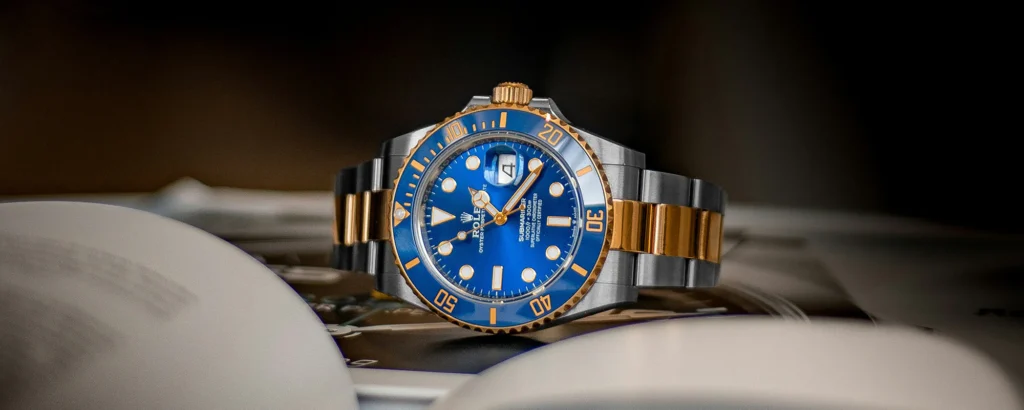
Pre-owned gives you more watch for your money, often with remaining warranty, and in many cases better value retention. A pre-owned Rolex Submariner in excellent condition with box and papers is a better financial decision than most new watches at the same price point.
Where to buy pre-owned: Chrono24, Bob’s Watches, WatchBox, or a reputable local dealer. Never from someone’s trunk. Never without authentication.
The Brands Worth Your First Luxury Purchase
Omega — The most correct first luxury watch for most men. Proven heritage, extraordinary movements, immediately recognizable without being flashy. The Seamaster or Speedmaster Professional is a perfect starting point.
Longines — The most underrated luxury watch brand in the world. Swiss made, beautiful design, movements that rival watches costing three times as much. The Master Collection is exceptional.
Tissot PRX — At $400-600 this is technically not luxury but it is the gateway. Integrated bracelet, automatic movement, sophisticated design. Buy this if you are not ready to commit to four figures.
TAG Heuer Carrera — The racing watch. Bold, legible, with a motorsport heritage that gives it a personality most dress watches lack. The man who leans toward the sporty side of dressed starts here.
IWC Portugieser — For the man who wants a dress watch with real presence. Large case, clean dial, extraordinary movement. The watch that makes every room feel slightly more formal.
The Rules of Buying
Buy what you love not what you think you should love. You will wear this watch every day. It needs to make you happy every time you look at it.
Buy the right size for your wrist. A 42mm watch on a small wrist looks wrong. A 36mm watch on a large wrist looks wrong. Try it on. Look in the mirror. Be honest.
Never buy a watch as an investment first. Buy it because you love it. If it holds or grows in value that is a bonus not a strategy.
Keep the box and papers. Always. They matter when you eventually sell or pass it on.
Service it properly. A mechanical watch needs service every 5-7 years. Budget for it. It is part of ownership.
The Watch That Changes Everything
There is a moment — usually about six months after buying your first real watch — when you look down at your wrist and understand something you could not have understood before you owned one.
The movement inside that case has hundreds of parts. Each one finished by hand. Each one working in concert with the others to move two hands around a dial once every twelve hours.
It does not need a battery. It does not need a signal. It needs nothing from you except to be worn.
That is not a small thing. That is craftsmanship at its highest level. And once you understand it you will never look at a watch the same way again.
There Goes That Man. The search is over.