
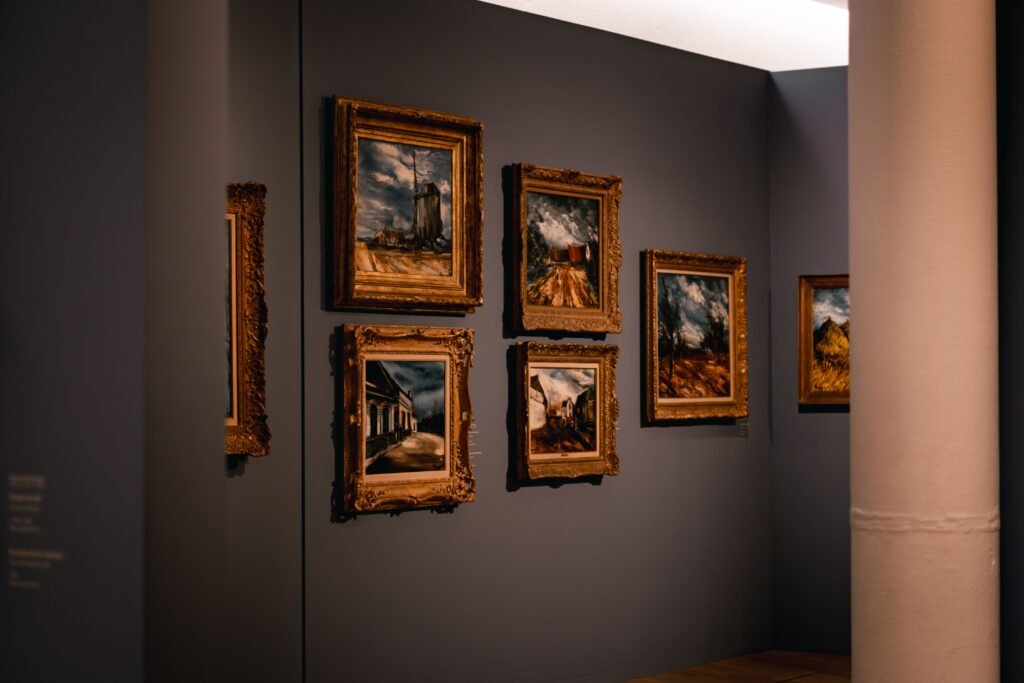
Most men think of art as decoration. Something that goes on the wall because the wall needs something on it. Something chosen to match the furniture or to fill a space that feels empty.
This is one way to think about art. It is not the most interesting way.
The man who understands art as an asset — as a store of value, as a hedge against inflation, as a category of investment that has produced extraordinary returns for informed buyers over decades — thinks about it differently. He buys what he loves. He also understands what he is buying and why it might be worth considerably more in ten years than it is today.
Here is how to think about it correctly.
First — Understand What Art Actually Is as an Asset
Art is an alternative asset. Like real estate, like private equity, like wine and watches and rare whiskey — it sits outside the traditional financial markets and behaves differently from stocks and bonds.
The correlation between art and the stock market is low. When equities fall art does not necessarily fall with them. This makes art valuable as a portfolio diversifier — an asset that does not move in lockstep with the rest of what you own.
Art is also a tangible asset. Unlike a stock certificate or a bond it exists physically. You can hang it on your wall. You can live with it. You can enjoy it every day while it potentially appreciates in value. No other asset class offers this combination of aesthetic pleasure and investment potential simultaneously.
The art market is large — approximately $65 billion in annual global sales — and growing. It is also inefficient, opaque, and relationship-driven in ways that financial markets are not. This inefficiency creates opportunity for the informed buyer that does not exist in more transparent markets.
The Returns — What the Numbers Say
The Mei Moses Art Index — the most cited academic measure of art market returns — has shown that art has outperformed the S&P 500 over multiple long-term time horizons when blue chip works are considered.
However the aggregate numbers conceal significant variation. The art market is not one market. It is thousands of micro-markets — by artist, by period, by medium, by provenance, by condition — that behave very differently from each other.
The Basquiat that sold for $110.5 million in 2017 was purchased for considerably less. The work by a mid-career artist that seemed promising in 2005 may have appreciated meaningfully or may have declined to near zero depending on whether the artist’s career developed as hoped.
The honest assessment: art can be an exceptional investment. It can also be a complete loss. The difference between the two outcomes is knowledge, relationships, patience, and some luck.
Where to Start — The Entry Points
Blue chip art — Works by established artists with proven auction records. Picasso, Warhol, Basquiat, Hirst, Koons, Kusama. These are the artists whose work is bought and sold at the major auction houses — Christie’s, Sotheby’s, Phillips — for prices that begin at tens of thousands and extend to tens of millions.
This is not the entry point for most men building an art collection for the first time. It is the destination for the man who has built wealth elsewhere and is now allocating a portion of it to art as a serious asset class.
Emerging and mid-career artists — The most interesting territory for the man building a collection with investment potential. Artists who have gallery representation, critical recognition, and a developing institutional exhibition history but whose work has not yet reached blue chip prices.
The risk is higher. An emerging artist whose career does not develop as hoped produces work that does not appreciate. The reward is the possibility of buying a work for $5,000-20,000 that is worth $50,000-200,000 in ten years if the artist’s career continues to develop.
Identifying these artists requires looking at what galleries are showing, what institutions are collecting, what critics are writing, and what other informed collectors are buying. It requires time, attention, and relationships with gallerists who trust you enough to offer you access to works before they are publicly available.
Art funds and fractional ownership — For the man who wants art market exposure without the complexity of direct collecting. Platforms like Masterworks allow investors to buy shares in individual blue chip artworks, providing art market returns without requiring the capital to purchase whole works or the expertise to select them.
The returns are potentially significant. The liquidity is limited — you are a minority owner of a physical object that must be sold as a whole before you can realize your investment. Understand this before investing.
Photography — The most accessible entry point for the serious collector. Fine art photography — limited edition prints by significant photographers — starts at prices most men can access and has a robust collector market, institutional support, and genuine investment track record.
Artists like Cindy Sherman, Andreas Gursky, Richard Prince, and Wolfgang Tillmans have produced work that has appreciated dramatically over decades. Emerging photography is equally interesting and considerably more affordable.
Prints and works on paper — Editions — prints, lithographs, screenprints — produced by significant artists are often available at fractions of the price of unique works. A signed Warhol print may cost $20,000-100,000 where a unique Warhol painting costs millions. The investment potential is real while the entry point is accessible.
How to Buy — The Channels
Galleries — The primary market. Works sold directly from the gallery representing the artist. Prices are fixed — galleries do not negotiate the way auction houses do. The relationship with the gallery is the value — access to works before they are publicly available, invitations to opening events, introductions to artists, preference when allocation is limited.
Build gallery relationships slowly and genuinely. Visit regularly. Buy when you can. Express genuine interest in the artists and the program. The gallery that trusts you gives you access the casual buyer never receives.
Auction houses — The secondary market. Christie’s, Sotheby’s, Phillips, Bonhams. Works consigned by previous owners sold to the highest bidder. Prices are transparent — the auction record is public — which makes the secondary market more efficient and the opportunities for underpayment rarer.
Buyer’s premium — the fee charged by the auction house on top of the hammer price — typically runs 25-26% on the first portion of the hammer price. Factor this into your calculations. A work that hammers at $100,000 costs you approximately $126,000 after premium and taxes.
Art fairs — Frieze, Art Basel, TEFAF, the Armory Show. Galleries from around the world present their programs simultaneously in a single venue. The density of quality and the concentrated access to gallerists make art fairs the most efficient way to survey the market in a short period.
Go to at least one major art fair annually if you are serious about collecting. Walk every booth. Look at everything. Buy nothing on the first day. Return on the second or third day for anything that stayed with you.
Online platforms — Artsy, 1stDibs, Saatchi Art. The democratization of the art market has made works available online that previously required gallery relationships to access. Quality varies enormously. Research artists thoroughly before buying online and purchase only from reputable platforms with clear return policies.
What to Look For — The Fundamentals of Quality
Institutional exhibition history — Has the artist shown at museums, kunsthalles, serious non-commercial institutions? Institutional interest is the most reliable indicator of critical seriousness and long-term career potential.
Gallery representation — Which gallery represents the artist? A strong gallery — one with an international program, serious collectors, and a history of developing important careers — provides infrastructure that supports an artist’s market.
Critical writing — Is serious criticism being written about the work? Reviews in significant publications, catalog essays by respected curators, inclusion in critical surveys of contemporary art — these indicate that the work is being taken seriously beyond its commercial potential.
Auction record — If the artist’s work has appeared at auction what has it achieved? Strong auction results indicate collector demand and provide a market benchmark. Works selling significantly above estimate indicate momentum.
Condition — The condition of a work of art directly affects its value. A damaged or poorly restored work is worth a fraction of the same work in excellent condition. Always request a condition report before purchasing. For significant purchases have an independent conservator examine the work.
Provenance — The ownership history of a work. Strong provenance — documented ownership by significant collectors or institutions — adds value and authenticity assurance. Works with gaps in provenance or provenance that cannot be verified require additional scrutiny.
The Storage and Care — The Responsibility of Ownership
Art is a physical object. It requires physical care.
Light is the primary enemy of works on paper and many paintings. UV-filtering glass protects works on paper. Avoid hanging art in direct sunlight regardless of medium.
Humidity and temperature fluctuations damage works on canvas and panel. Maintain consistent environmental conditions — 65-70°F, 45-55% relative humidity — in spaces where significant works are displayed or stored.
For significant works consider professional art storage — climate controlled, security monitored, fire suppressed facilities used by museums and serious collectors. The cost is justified for works of significant value.
Insurance — specific art insurance from a provider who understands the market. Standard homeowner’s insurance is inadequate for serious collections. Chubb and AXA Art are the specialist providers.
The Authenticity Question
Forgery is a real phenomenon in the art market. Not in the primary market — galleries selling directly from artists they represent — but in the secondary market where works change hands without the artist’s involvement.
For any significant secondary market purchase obtain an authentication from the artist’s foundation or estate, the catalogue raisonné — the scholarly record of the artist’s complete work — or a recognized authentication board.
For contemporary artists authentication is generally straightforward. For historical works it is complex, expensive, and sometimes genuinely uncertain. The man who buys a work he cannot authenticate has bought a risk he may not have intended.
The Tax Considerations
Art is subject to capital gains tax when sold at a profit. In the United States long-term capital gains — works held for more than one year — are taxed at 20% for most high-income earners plus a 3.8% net investment income tax.
Donating appreciated art to a qualifying museum or institution allows a deduction at fair market value — the full appreciated value, not cost basis. This is one of the most favorable tax treatments available for any asset class.
Consult a tax advisor with art market experience before making significant purchases or sales.
The Beginning
Start with what you love. Always. The man who buys art he does not love for investment purposes alone has made a mistake regardless of whether the investment succeeds — because he will live with something he does not love and feel neither the pleasure of the object nor the confidence of genuine conviction.
Buy what moves you. Then learn everything you can about why it moves you, who made it, what tradition it belongs to, where the artist is in their career, and what informed collectors and institutions think of it.
The investment case follows from genuine engagement with the work. The man who loves what he collects learns more, looks harder, develops better relationships, and makes better decisions than the man who approaches art purely as a financial calculation.
Go to galleries. Go to museums. Go to art fairs. Look at everything. Buy slowly. Buy well. Build something over time that reflects who you are and what you value.
That is a collection. That is different from a wall with things on it.
There Goes That Man. The search is over.