
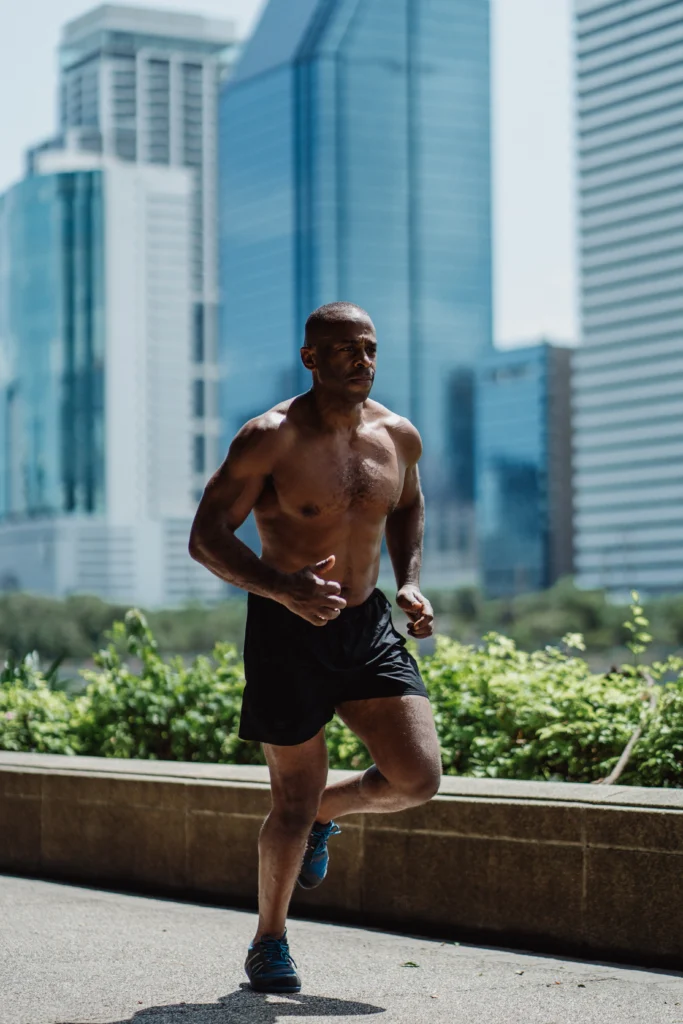
Most men who say they hate running have never run correctly.
They started too fast, too far, too soon. Their knees hurt. Their lungs burned. They finished feeling worse than when they started and concluded that running was not for them.
Running done correctly feels nothing like that. Done correctly it is one of the most meditative, most physically transformative, and most accessible forms of exercise available to any man regardless of his current fitness level.
Here is how to do it correctly.
Why Running — The Case for the Man Who Is Not Convinced
Running requires no equipment beyond shoes. No gym membership. No class schedule. No spotter. No waiting for equipment. You walk out your front door and begin.
Running produces measurable improvements in cardiovascular health, cognitive function, mood, sleep quality, bone density, and longevity. The research on running and all-cause mortality is consistent and significant — regular runners live longer, on average, by three years compared to non-runners. Not three years of declining health. Three additional years of functional life.
Running produces the clearest head of any activity most men have access to. The man who runs before a difficult meeting, a difficult conversation, or a difficult day approaches those things differently than the man who does not. Something about sustained rhythmic movement and the accompanying neurochemistry — the endorphins, the endocannabinoids, the dopamine — produces a mental clarity that most other activities cannot replicate.
Running is also honest. It measures exactly what you put in and returns it precisely. The man who runs consistently gets faster, goes further, and feels better. The man who does not gets none of those things. The feedback loop is immediate and unambiguous.
The Gear — Start Here Before Anywhere Else
Running in the wrong shoes is the fastest path to injury and the most common reason men stop running before they discover whether they enjoy it.
The shoes — The only investment that matters at the start
Running shoes are not all-purpose athletic shoes. They are engineered for the specific biomechanics of running — the heel strike or midfoot strike, the pronation of the foot, the cushioning required for impact absorption over hundreds of footstrikes per mile.
Go to a running specialty store — not a general sporting goods retailer. A running specialty store will watch you walk and jog, analyze your gait, and recommend shoes appropriate for your foot type and running style. This service is free. Use it.
What to expect to spend: $120-180 for quality running shoes from brands that have earned their reputation through actual performance.
Brands worth wearing:
Brooks Ghost — The most recommended everyday training shoe. Neutral cushioning, reliable fit, works for most runners most of the time.
New Balance Fresh Foam 1080 — Maximum cushioning, exceptionally comfortable, excellent for higher mileage training.
ASICS Gel-Kayano — For overpronators — runners whose feet roll inward during the stride. Stability features correct the motion without sacrificing comfort.
Saucony Kinvara — Lighter weight, more responsive, for the runner who wants something faster feeling than maximum cushion shoes.
Hoka Clifton — Maximal cushioning on a lightweight platform. The shoe that converted thousands of men who thought running hurt their joints because running in their old shoes hurt their joints.
Replace running shoes every 300-500 miles. The cushioning degrades before the shoe looks worn. Running in dead shoes is running in no shoes from an impact protection standpoint.
The clothing — Secondary but not irrelevant
Technical running fabric — moisture-wicking polyester or nylon — makes a meaningful difference in comfort over longer runs. Cotton holds sweat against your skin, chafes, and becomes heavy. Technical fabric moves sweat away from your skin and dries quickly.
Shorts — Running-specific shorts with a liner eliminate the need for separate underwear and prevent chafing. Lululemon Pace Breaker or Nike Dri-FIT Challenger are the standards.
Shirts — Any moisture-wicking technical shirt. This is not the place to overthink it.
Socks — More important than most men realize. Thin running-specific socks prevent blisters better than thick athletic socks. Balega Hidden Comfort or Darn Tough Running are the recommendations.
In cold weather — A lightweight moisture-wicking base layer and a wind resistant outer layer. Patagonia Houdini jacket weighs four ounces and packs to nothing. It is the wind layer that makes running in cold weather tolerable.
The Watch — Optional but Useful
A GPS running watch tracks pace, distance, heart rate, and over time builds a picture of your progress that is genuinely motivating.
Garmin Forerunner 265 — The benchmark GPS running watch at a reasonable price. Accurate GPS, reliable heart rate monitoring, training load analysis, recovery recommendations.
Apple Watch Series 9 — For the man already in the Apple ecosystem. Less running-specific functionality than Garmin but sufficient for most non-competitive runners.
A watch is not necessary to start. It becomes valuable when you care about your progress enough to measure it precisely.
The Start — How to Actually Begin
The most common mistake is starting with running.
Begin with walking. Specifically begin with the run-walk method — alternating intervals of running and walking that allow your cardiovascular system and your connective tissue to adapt to the demands of running without breaking down.
Your cardiovascular fitness will improve faster than your tendons, ligaments, and bones adapt to impact. The run-walk method respects this difference and prevents the overuse injuries that end most new running programs before they produce results.
The beginner program — Eight weeks to running 30 minutes continuously:
Weeks 1-2: Walk 5 minutes. Run 1 minute, walk 2 minutes. Repeat 5 times. Walk 5 minutes. Three times per week.
Weeks 3-4: Walk 5 minutes. Run 2 minutes, walk 2 minutes. Repeat 5 times. Walk 5 minutes. Three times per week.
Weeks 5-6: Walk 5 minutes. Run 5 minutes, walk 2 minutes. Repeat 4 times. Walk 5 minutes. Three times per week.
Weeks 7-8: Walk 5 minutes. Run 10 minutes, walk 2 minutes. Repeat 2-3 times. Walk 5 minutes. Three times per week.
By week eight most men can run 20-30 minutes continuously. The progression from there is straightforward — add time gradually, never more than 10% per week, until you reach your goal distance or duration.
The Pace — Slower Than You Think
Most new runners run too fast. The pace that feels sustainable for the first few minutes is not the pace that is sustainable for thirty minutes.
The correct pace for easy running is the pace at which you can hold a full conversation. Not gasp out words between breaths. Actually converse. If you cannot speak in complete sentences you are running too fast.
This pace will feel embarrassingly slow at first. Run it anyway. The aerobic base built at easy effort is the foundation that makes faster running possible later. The man who runs every run at maximum effort builds no aerobic base, never improves, and eventually stops running. The man who runs most runs easy and occasionally runs hard builds fitness that compounds month over month.
The Form — What to Actually Think About
Running form is not as complicated as running media makes it appear. There are a few principles that matter and everything else is optimization for competitive runners.
Posture — Run tall. Imagine a string attached to the top of your head pulling you gently upward. A slight forward lean from the ankles — not the waist. Shoulders relaxed and back not hunched forward.
Arms — Swing from the shoulder not the elbow. Arms move forward and back not across the body. Hands relaxed — imagine holding a potato chip without crushing it.
Cadence — The number of steps per minute. Most recreational runners run at 150-160 steps per minute. Elite runners run at 170-180. Increasing cadence slightly — by 5-10% — reduces impact forces and often reduces injury risk. A metronome app set to your target cadence is an easy way to calibrate this.
Foot strike — Where your foot lands relative to your body. Landing with your foot in front of your center of mass — overstriding — creates a braking force and increases impact. Landing beneath your center of mass is more efficient and less injurious. The best cue — imagine running over hot coals. Quick, light, beneath you.
The Breathing — Breathe naturally. In through the nose and mouth. Out through the mouth. Match your breathing rhythm to your stride if it helps. At easy pace this is not difficult. At hard effort breathe however your body demands.
The Route — Make It Worth Running
The man who runs the same route every day eventually stops running. Variety maintains motivation.
Run roads early in the program when the focus is on building fitness. Trails when you are ready for the additional challenge and the considerably greater enjoyment of moving through nature.
Explore your city on foot. The neighborhood you have driven through a hundred times reveals itself differently at running pace. Details invisible from a car become visible — architecture, gardens, the lives being lived behind windows, the quality of light at six in the morning.
A running route that passes a coffee shop creates a built-in reward. A running route that ends at a viewpoint creates a built-in destination. Build your routes with intention.
The Music and Podcasts — An Opinion
Running with music or podcasts is not cheating. It is a tool. For many men it is the tool that makes the difference between going and not going.
Run without audio occasionally. The man who runs in silence through a city waking up or through a forest at dawn experiences something that earphones prevent. Both have value. Choose intentionally rather than defaulting.
If running with music — an energetic playlist for hard efforts, something more meditative for easy runs. If podcasts — the long-form conversation or documentary that does not require visual engagement.
The Community — Optional but Powerful
Running clubs exist in virtually every city and town. They range from casual social groups to competitive training teams. The man who finds a group that matches his pace and his temperament has found a significant motivational advantage.
Running with others pushes you on days you would slow down alone. It creates accountability on days you would not go at all. It produces friendships that form in the particular way that shared physical effort produces — quickly, honestly, without the social performances that other contexts require.
Look for local running clubs through running specialty stores, Meetup, or Strava.
The Races — Why to Enter One Before You Are Ready
Signing up for a race before you feel ready is one of the most effective motivational tools available.
A 5K — 3.1 miles — is the correct starting race. Achievable for any man who has completed the beginner program above. The experience of crossing a finish line — even a modest one — produces something that no training run replicates. It shows you what you are capable of. It sets a baseline. It almost always produces a desire to do it again faster.
Register for one. Put it on the calendar. Train for it specifically. Run it. Everything that comes after is easier because of it.
The Long Game
Running is one of the few physical activities that improves with decades of consistent practice. The man who runs at 35 and continues running consistently is a better runner at 55 than most men who start at 55.
The cardiovascular adaptations compound. The efficiency improves. The enjoyment deepens as the effort required for a given pace decreases and the ability to run further and longer develops.
The man who runs regularly for twenty years has done something for his health, his mental clarity, and his longevity that no supplement, no biohack, and no financial investment can replicate.
It requires only shoes, time, and the decision to begin.
Begin.
There Goes That Man. The search is over.